
This year I’ve read two books on abusive relationships that I quite liked; or rather what I liked about them was that they focused on a subset of abuse that is easily downplayed- psychological abuse.
It doesn’t come as a surprise how psychological (emotional) abuse is overlooked because we as humans love evidence, proof, and physical/sexual abuse easily delivers on a platter. Here is the black eye, here is the bruise on their face, here is the blood, here is the forensic evidence. Emotional abuse, on the other hand, is strategic. It gaslights and manipulates and can feel passionate.
The two books I’m about to recommend have really opened my eyes to this form of abuse and I feel like everyone regardless of your situation needs to read them (or at least read ‘In the dream House’. 5/5 would recommend).
In the Dream House- Carmen Maria Machado
RATING: ★★★★★
‘You cried in front of many people. You missed readings, parties, the supermoon. You tried to tell your story to people who didn’t know how to listen. You made a fool of yourself, in more ways than one. I thought you died, but writing this, I’m not sure you did.’
‘In the Dream House’ is a memoir about Carmen’s (the author) experience in a same-sex relationship with her abusive ex. Emphasis on the same-sex relationship because I believe one of the points she wanted to make was that people often assume heterosexual relationships when they think about abuse BUT there is also abuse in same-sex relationships and it’s not always physical.
I knew from the excerpt that I was going to love this book. The writing is in second person which apparently, most people hated (since it’s a memoir) but I thought it was beautiful. It’s the kind of writing that lets you totally immerse yourself into the story. You read a page and then you read it again, and then you listen to it, cus you want it to wash over you- to make sure you understand what the teller is trying to say.
The book is divided into short chapters like Dream House as a Stranger Comes to Town, Dream House as Romance Novel, Dream House as Warning, where we experience (as though we were a detached version of herself) her meet the woman in the dream house (a ‘euphemism’?…for her ex), the dream house being the house she lived in with the ex.
For lack of the right words to describe this book, I’d list some of my favourite chapters and excerpts from said chapters.
Dream House as World Building
Here she talks about how abuse usually starts with isolation, loss of one’s support system.
“Later, you will learn that a common feature of domestic abuse is “dislocation.” That is to say, the victim has just moved somewhere new, or she’s somewhere where she doesn’t speak the language, or has been otherwise uprooted from her support network, her friends or family, her ability to communicate.”
Dream House as Lost in Translation
Here she talks about gaslighting.
“You say what you are thinking and you say it after thinking a lot, and yet when she repeats what you’ve said back to you, nothing makes sense. Did you say that? Really? You can’t remember saying that or even thinking it, and yet she is letting you know that it was said, and you definitely meant it that way”.
Dream House as a Pathetic Fallacy
“…but then she does that thing where she repeats what you’ve said a few times, each time getting a little more sarcastic until you apologise, though you never know what you are apologising for.”
Dream House as Man vs. Self
Here she tells a story of her mother’s dog, a metaphor for how herself (and most victims) don’t see leaving as an option even if it’s obvious to an outsider.
“One day, you picked her up, put her by the door, and opened it. “Greta,” you said, “go on! Be free! Run!” She just looked at you with the saddest, most mournful expression. She could have run. The door was open. But it was as if she didn’t even know what she was looking at.”
Dream House as Comedy of Errors
“And as the ground gets farther and farther away you swear to yourself that you’re going to tell someone how bad it is, you’re going to stop pretending like none of these things are happening, but by the time the ground is coming toward you again you are already polishing your story”
Dream House as Demonic Possession
Here she talks about making excuses for the abuser’s behaviours because your brain refuses to believe that someone can both love you and hurt you.
“That’s what you want. You want an explanation that clears her of responsibility, that permits your relationship to continue unabated. You want to be able to explain to others what she’s done without seeing horror on their faces… Isn’t that the best part of a possession story that the inflicted can do and say horrific things…?”
Dream House as Death Wish
“Afterwards…when people do not believe what you tell them about her…you’ll wish she had hit you. Hit you hard enough that you’d have bruised in grotesque and obvious ways”.
As vile as this sounds, you see where she’s coming from when you see how people invalidate physiological abuse.
There is no one way to tell your story but I loved how Carmen wove hers. It’s mesmerising and really gets you thinking and empathizing. It’s not an easy read but it’s a recommended one.
The second book I read was ‘The Places I’ve Cried in Public’ and this, unlike ‘In the Dream House’ is fiction, and follows a heterosexual couple.
The Places I’ve Cried in Public- Holly Bourne
RATING: ★★★★
“Can you see the girl crying”
*Me looking around to see if there’s another girl crying*
‘The places I’ve cried in public’ is an upsetting story about a girl (Amelie) who in present time reflects on her relationship with her abusive ex, Reese. She revisits all the places he made her cry trying to find out what went wrong, where it all went wrong but slowly discovers along the way that it wasn’t the fairy tale she’d believed it was.
I say it’s upsetting cause as a reader watching from the outside, you can start seeing hints of the red flags waving from a mile away from the first time we meet this boy.
But here’s what I’ve learnt from reading these two books. The abuser doesn’t give the victim the space to notice any red flags. They do what this article calls ‘Barrage of Love’
It all started with love bombing, mirroring and flattery, leaving no space for me to see chaos and red flags. The relationship was possessive and obsessive, filled with poetic language, movie-esque intoxicating love and grand gestures. It was intense and short lived.
And this is the holy grail the victim keeps seeking after things turn sour.
Eventually, Amelie starts to see the shifts in Reese’s behaviour but of course she excuses them. Which is another thing Carmen mentioned in her story. Excusing the abuser’s behaviour.
At this point in the story, she’s treading on eggshells. Picking her words so she doesn’t offend him, apologising profusely even when it’s quite obvious she’s not in the wrong. You start to see him feed on her vulnerability till she believes she’s completely worthless.
It’s interesting to follow.
Amelie and Carmen, I wouldn’t think have anything in common. Which goes on to prove that just anyone can be abused. Victims aren’t always naive people. It just takes meeting the wrong person at the wrong time in your life.
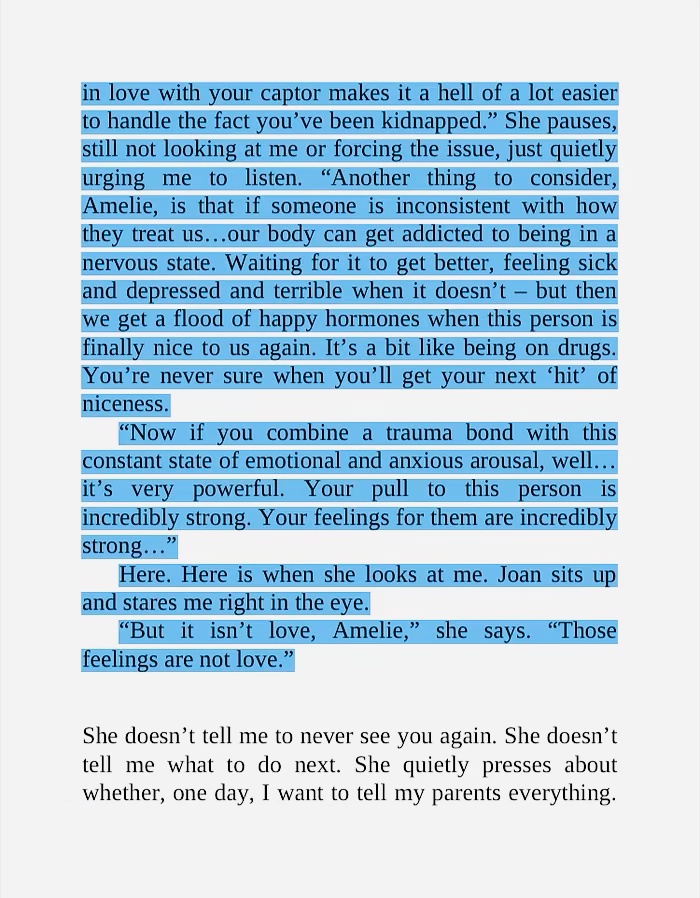
Amelie goes on to seek therapy and her sessions with her therapist help her see that what she thought was a passionate love affair was in fact toxic, abusive.
I’d attach an excerpt of a conversation they had I thought was important.
As I said earlier, I’d definitely recommend these books. Maybe ‘The Places I’ve cried in Public’ for a younger audience and ‘In the Dream House’ for (young)adults.
I believe they both pass the same general message but on homosexual and heterosexual relationships respectively.
Besides I think there’s something to think about on how teenage girls crying in public is often overlooked.
If you enjoyed this book review, check out my other book reviews let me know your favourites books that deal with emotional abuse.
 quintessentially C
Leave a comment